
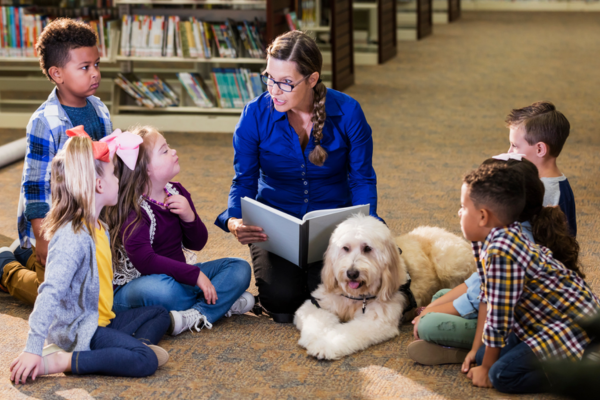
For many students, school is where they first learn to interact with the world around them. They learn how to treat others, how to ask questions, and how to navigate differences with respect. Yet when it comes to service dogs, there is often a gap in understanding.
Without guidance, curiosity can quickly turn into a distraction. Questions can become invasive, and small moments can unintentionally create unsafe situations for service dog teams. That’s why service dog education in schools matters more than ever.
Service Dogs are Part of Everyday Life
Service dogs are not rare. They are present in grocery stores, restaurants, airports, and of course, schools. As more individuals with service dogs move through public spaces, students are increasingly likely to encounter them in real life.
Unfortunately, without education, many students:
- Don’t understand that service dogs are working
- Assume it’s okay to approach or pet them
- Ask personal or inappropriate questions
- Don’t recognize the importance of giving space
These misunderstandings aren’t intentional, but they can have real consequences.
Curiosity Without Guidance Can Create Risk
Children are naturally curious. When they see a dog, their instinct is often to engage by smiling, waving, talking, or reaching out. In most situations, that’s a harmless reaction. With a service dog, it’s very different.
Distractions can interrupt critical tasks, whether that’s guiding a handler, providing mobility support, or alerting to a medical condition. Even a moment of lost focus can put someone at risk.
Without being taught otherwise, students may unknowingly:
- Call out to the dog
- Try to pet or interact
- Crowd the handler
- Create noise or excitement that breaks concentration
These moments may seem small, but for a service dog team, they can impact safety, independence, and confidence in public spaces.
Teaching Respect, Not Fear
Service dog education isn’t about telling students to ignore or avoid these teams; it’s about teaching respectful, informed behavior.
When students understand:
- A service dog is a working partner, not a pet
- The handler’s safety depends on the dog’s focus
- Personal questions about disability are not appropriate
- Giving space is a form of respect
They don’t just change their behavior; they become part of the solutions. Education empowers students to replace uncertainty with confidence and curiosity with awareness.
Building Inclusive Schools from the Ground Up
Inclusion doesn’t happen by accident. It’s something that must be taught, modeled, and reinforced. When schools incorporate service dog education, they:
- Create safer environments for students, staff, and visitors with service dogs
- Reduce the likelihood of harmful or disruptive interactions
- Foster empathy and understanding among students
- Normalize accessibility and respect for all abilities
These lessons extend far beyond service dogs. They shape how students approach differences, advocate for others, and participate in their communities.
Why This Matters More Than Ever
We are living in a time where awareness of accessibility and inclusion is growing, but gaps in understanding still exist.
Service dog teams continue to face:
- Distractions in public spaces
- Invasive questioning
- Denied access due to misinformation
Many of these challenges begin with a simple lack of education. By reaching students early, schools have the opportunity to shift this narrative. Instead of correcting harmful behaviors later, we can prevent them from happening in the first place.
How Justice Speaks is Making an Impact
This is where Justice Speaks steps in. Through school-based education programs, Justice Speaks provides students with the tools and understanding they need to interact safely and respectfully with service dog teams.
These programs go beyond theory. They focus on:
- Real-world scenarios students are likely to encounter
- Clear, practical guidance on what to do, and what not to do
- Age-appropriate education that builds confidence and awareness
- Empowering students to become advocates in their own communities
Students don’t just learn what a service dog is; they learn how their behavior directly impacts someone’s independence and safety. And that understanding sticks.
Shaping the Next Generation of Advocates
When students are given the right tools, they don’t just follow rules; they lead by example.
They:
- Remind peers not to distract working dogs
- Show respect in public spaces
- Ask thoughtful, appropriate questions
- Carry these lessons into adulthood
Over time, this creates a ripple effect. One educated classroom becomes a more informed community. And those communities become safer, more inclusive spaces for service dog teams everywhere.
Education is the Foundation of Change
At its core, the challenges faced by service dog handlers are not caused by bad intentions; they are caused by a lack of understanding. And that’s something we can change!
By bringing service dog education into schools, we are:
- Protecting the safety of service dog teams
- Preserving the dignity and independence of handlers
- Creating environments where inclusion is the norm, not the exception
A Simple Lesson with Lasting Impact
The next time a student sees a service dog, their reaction matters. With education, that reaction becomes: Respect, awareness, and understanding. That’s the impact of education, and it starts in the classroom.